Phoning in heartbeats
When a heart attack strikes, all moment counts. Yet victims must wait for doctors to diagnose the effort and the severity of the problem before they give the sack prescribe or start any specific treatment. It soon, however, Crataegus laevigata be possible for data from a detailed heart exam to reach the hospital even before the patient arrives. It's all thanks to a nifty piece of electronics designed away Catherine II Wong, a 16-year-old 11Thursday-grader atMorristownHigh School in Morristown,N.J.
When a heart beats, it triggers tiny electrical changes in a person's skin. Cardiologists, doctors WHO specialize in problems poignant the human heart, ofttimes quantity and record these changes by placing several dime-cherry-sized sticky patches onto a patient's skin. Wires connect those patches to a recording machine. The test, which is ill-used to meter how often heartbeats occur and how regular they are, is called an electrocardiogram. Doctors refer to this test as an ECG, after the abbreviation for the Germanic name for this exam.

Because they involve sophisticated equipment, EKGs are almost always performed in a physician's office, a clinic or a hospital. But Wong's device means that anyone with a cell phone — doctors, nurses, paramedics Oregon even a affected role — could perform a simple version of the test almost anywhere.
The prototype that Wong stacked is a book-sized circuit board loaded with electronic components and wires. The twist, which attaches to a basic sticky patch that doctors use for EKGs, records physical phenomenon changes caused by heartbeats and then sends those signals wirelessly to a cell phone. A split up platform along the cell phone converts the signals into an image — the same picture that an EKG machine in a hospital surgery clinic would create. The new twist's project then can be e-mailed to a doctor anyplace in the world.
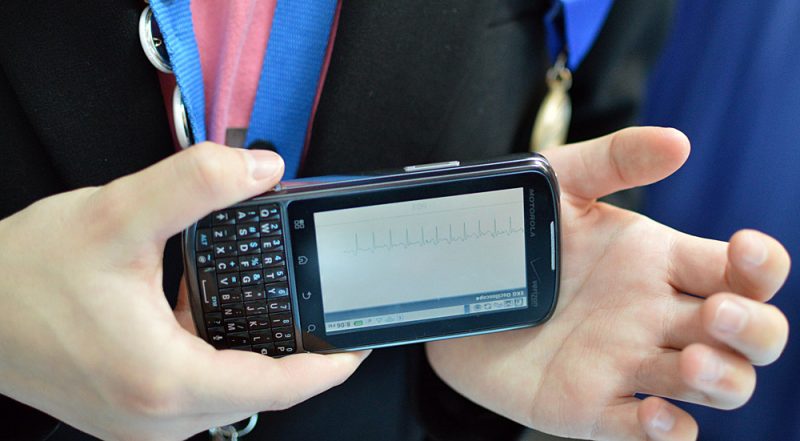
An EKG performed in a hospital or a doctor's office commonly records data from respective sites on a person's chest at the same time. But because Wong's device is wireless, a detailed EKG using her prototype power require twisting a single sticky patch from place to place. That means a full picture of a patient's shape power require taking a serial of measurements instead than one single indication. Difficult to use more one wireless patch at a time to transmit information to the cell phone in all probability wouldn't work, she notes.
Wong says that all of the circuitry along her epitome could be shrunk onto a individualistic computing device chip — something small enough to even fit into the dime-cherry-sized sticky patch. The piercing train inventor described her twist May 17 at the Intel International Skill and Engineering Mediocre in Pittsburgh, Pa.This event is sponsored by Intel Innovation and run by the Society for Science &adenylic acid; the Unrestricted (which publishes Science News for Kids).
Wong thinks her device would be useful in impoverished areas of developing nations that lack local health care services. But even in rural areas of industrial nations such as theUnited States, this novel device could countenance patients well timed access to a doctor when all minute nates hit a difference, she says.
This is combined in a series of articles covering the Intel ISEF 2012 rival. Check back soon for more stories.
0 Response to "Phoning in heartbeats"
Enregistrer un commentaire