Native Women With Black Wolf Native Women With Wolf Art

The wolf is a common motif in the foundational mythologies and cosmologies of peoples throughout Eurasia and North America (corresponding to the historical extent of the habitat of the gray wolf). The obvious attribute of the wolf is its nature of a predator, and correspondingly information technology is strongly associated with danger and destruction[ citation needed ], making information technology the symbol of the warrior on one paw, and that of the devil on the other[ citation needed ]. The modern trope of the Large Bad Wolf is a development of this. The wolf holds great importance in the cultures and religions of the nomadic peoples, both of the Eurasian steppe and North American Plains.
Wolves were sometimes associated with witchcraft in both northern European and some Native American cultures: in Norse folklore, the völva (witch) Hyndla and the giantess Hyrrokin are both portrayed as using wolves equally mounts, while in Navajo civilisation, wolves were feared equally witches in wolf'south article of clothing.[1] Similarly, the Tsilhqot'in believed that contact with wolves could cause mental illness and death.[ii]
Akkadian [edit]
One of the earliest written references to black wolves occurs in the Babylonian epic Gilgamesh, in which the titular character rejects the sexual advances of the goddess Ishtar, reminding her that she had transformed a previous lover, a shepherd, into a wolf, thus turning him into the very animal that his flocks must exist protected against.[three]
Caucasian [edit]
The names of nation of Georgia derives from Old Western farsi designation of the Georgians vrkān (𐎺𐎼𐎣𐎠𐎴) meaning "the land of the wolves", that would eventually transform into gorğān, term that will exist finding its way into nigh European languages equally "Georgia".[4]
The wolf is a national symbol of Chechnya.[5] Co-ordinate to folklore, the Chechens are "born of a she-wolf", every bit included in the central line in the national myth.[five] The "alone wolf" symbolizes force, independence and freedom.[5] A proverb most the teips (clans) is "equal and gratis like wolves".[6]
Finno-Ugric [edit]
Finnish [edit]
Dissimilar the fox and the carry, the wolf has been feared and hated in Republic of finland for a long fourth dimension. The wolf has been the symbol of destruction and desolation to the extent that the very word for wolf in the Finnish language, susi, also means "a useless affair", and the past-name hukka ways perdition and annihilation. While the behave has been the sacred animal of the Finns, wolves accept been hunted and killed mercilessly for a long time. The wolf has been represented as an implacable and malicious predator, killing more than it manages to eat.[ citation needed ]
Indo-European [edit]
In Proto-Indo-European mythology, the wolf was presumably associated with the warrior class (kóryos), who would "transform into wolves" (or dogs) upon their initiation. This is reflected in Iron Historic period Europe in the Tierkrieger depictions from the Germanic sphere, among others. The standard comparative overview of this attribute of Indo-European mythology is McCone (1987)[vii]
Baltic [edit]
According to legend, the establishment of the Lithuanian capital Vilnius began when the one thousand duke Gediminas dreamt of an atomic number 26 wolf howling about the loma. Lithuanian goddess Medeina was described as a single, unwilling to get married, though voluptuous and beautiful huntress. She was depicted as a she-wolf with an escort of wolves.
Dacian [edit]
In his volume From Zalmoxis to Genghis Khan, Mircea Eliade attempted to requite a mythological foundation to an alleged special relation between Dacians and the wolves:[eight]
- Dacians might accept chosen themselves "wolves" or "ones the same with wolves",[9] [8] suggesting religious significance.[10]
- Dacians draw their name from a god or a legendary ancestor who appeared every bit a wolf.[10]
- Dacians had taken their proper name from a group of fugitive immigrants arrived from other regions or from their own young outlaws, who acted similarly to the wolves circling villages and living from looting. As was the instance in other societies, those young members of the community went through an initiation, peradventure up to a yr, during which they lived equally a "wolf".[11] [x] Comparatively, Hittite laws referred to avoiding outlaws as "wolves".[12]
- The existence of a ritual that provides 1 with the ability to turn into a wolf.[13] Such a transformation may be related either to lycanthropy itself, a widespread phenomenon, but attested peculiarly in the Balkans-Carpathian region,[12] or a ritual imitation of the beliefs and appearance of the wolf.[13] Such a ritual was presumably a military initiation, potentially reserved to a hole-and-corner alliance of warriors (or Männerbünde).[13] To get formidable warriors they would assimilate behavior of the wolf, wearing wolf skins during the ritual.[10] Traces related to wolves as a cult or as totems were found in this area since the Neolithic period, including the Vinča civilisation artifacts: wolf statues and fairly rudimentary figurines representing dancers with a wolf mask.[xiv] [xv] The items could indicate warrior initiation rites, or ceremonies in which immature people put on their seasonal wolf masks.[15] The element of unity of behavior virtually werewolves and lycanthropy exists in the magical-religious experience of mystical solidarity with the wolf past whatsoever means used to obtain it. But all accept 1 original myth, a master outcome.[xvi] [17]
Germanic [edit]

Fenrir, spring by the gods
Norse mythology prominently includes three malevolent wolves, in particular: the giant Fenrisulfr or Fenrir, eldest kid of Loki and Angrboda who was feared and hated by the Æsir, and Fenrisulfr's children, Sköll and Hati. Fenrir is spring by the gods, just is ultimately destined to grow too large for his bonds and devour Odin during the class of Ragnarök. At that time, he volition have grown so large that his upper jaw touches the sky while his lower touches the globe when he gapes. He volition be slain past Odin's son, Viðarr, who will either stab him in the eye or rip his jaws disconnected, according to unlike accounts.[18] Fenrir's ii offspring will, co-ordinate to legend, devour the sun and moon at Ragnarök. On the other hand, however, the wolves Geri and Freki were the Norse god Odin's faithful pets who were reputed to be "of good omen."[19]
Wolves were seen as both being negative and positive to the Norse people. On one mitt, they can represent chaos and devastation (east.g. Fenrir, Skoll, and Hati), while on the other paw, they can also stand for bravery, loyalty, protection, and wisdom.
In the Hervarar saga, king Heidrek is asked by Gestumblindi (Odin), "What is that lamp which lights upwards men, but flame engulfs it, and wargs grasp afterwards information technology always." Heidrek knows the reply is the Sun, explaining: "She lights up every land and shines over all men, and Skoll and Hatti are called wargs. Those are wolves, ane going before the dominicus, the other afterward the moon."
Simply wolves also served every bit mounts for more or less dangerous humanoid creatures. For instance, Gunnr'due south horse was a kenning for "wolf" on the Rök runestone, in the Lay of Hyndla, the völva (witch) Hyndla rides a wolf, and to Baldr's funeral, the giantess Hyrrokin arrived on a wolf.
Wolf or Wulf is used equally a surname, given name, and a name among Germanic-speaking peoples. "Wolf" is also a component in other Germanic names:
- Wolfgang (wolf + gang ("path, journey"))
- Adolf, derived from the Old German language Athalwolf, a composition of athal, or adal, significant noble, and wolf; its Anglo-Saxon cognate is Æthelwulf.
- Rudolf, deriving from two stems: Rod or Hrōð, meaning "fame", and olf pregnant "wolf" (encounter as well Hroðulf).
Greek [edit]
The Ancient Greeks associated wolves with the sun god Apollo.[2]
Mount Lykaion ( Λύκαιον ὄρος ) is a mountain in Arcadia where an altar of Zeus was located. Zeus Lykaios was said to have been built-in and brought up on it, and was the home of Pelasgus and his son Lycaon, who is said to have founded the ritual of Zeus skillful on its tiptop. This seems to have involved a man sacrifice, and a feast in which the man who received the portion of a human victim was inverse to a wolf, as Lycaon had been after sacrificing a child. The sanctuary of Zeus played host to athletic games held every four years, the Lykaia.
Co-ordinate to Suda the bodyguards of Peisistratos were called wolf-feet (Λυκόποδες), because they always had their feet covered with wolf-skins, to prevent frostbite; alternatively because they had a wolf symbol on their shields.[20]
Indic [edit]
In the Rig Veda, Ṛjrāśva is blinded by his father equally penalization for having given 101 of his family's sheep to a she-wolf, who in turn prays to the Ashvins to restore his sight.[21] Wolves are occasionally mentioned in Hindu mythology. In the Harivamsa, Krishna, to convince the people of Vraja to drift to Vṛndāvana, creates hundreds of wolves from his hairs, which affright the inhabitants of Vraja into making the journeying.[22] Bhima, the voracious son of the god Vayu, is described equally Vrikodara, meaning "wolf-stomached".[23]
Iranic [edit]
Co-ordinate to Zoroastrian legends, Zoroaster as a kid was carried by the devs (the gods) to the lair of the she-wolf, in expectation that the fell animal would impale it; only she accepted it amongst her own cubs, and Vahman brought an ewe to the den which suckled it. (It was impossible in the Zoroastrian fable for the wolf herself to give milk to the baby, since wolves are regarded equally daevic creatures.) [24] According to the Avesta, the sacred text of the Zoroastrians, wolves are a creation from the 'darkness' of the evil spirit Ahriman, and are ranked among the most cruel of animals.[25] and belong to the daevas. The Bundahishn, which is a Middle Persian text on the Zoroastrian cosmos myth, has a chapter dedicated to the 'nature of wolves' as seen in Zoroastrian mythology and belief.
Wusuns, an Indo-European[26] semi-nomadic steppe people of Iranian origin,[27] had a fable that subsequently their male monarch Nandoumi was killed past Yuezhi, another Indo-European people, Nandoumi'south babe son Liejiaomi was left in the wild and He was miraculously saved from hunger beingness suckled by a she-wolf, and fed meat by ravens.[28] [29] [30] [31]
Roman [edit]
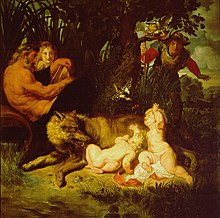
In Roman mythology wolves are mainly associated to Mars, god of war and agriculture. The Capitoline Wolf nurses Romulus and Remus, sons of Mars and hereafter founders of Rome. The twin babies were ordered to be killed past their great uncle Amulius. The retainer ordered to kill them, however, relented and placed the two on the banks of the Tiber river. The river, which was in inundation, rose and gently carried the cradle and the twins downstream, where nether the protection of the river deity Tiberinus, they would exist adopted by a she-wolf known as Lupa in Latin, an animal sacred to Mars. As a effect, the Italian wolf is the national brute of the modernistic Italian Democracy.
In Antiquity, the she-wolf was identified every bit a symbol of Rome by both the Romans themselves and nations under the Roman dominion. The Lupa Romana was an iconic scene that represented in the get-go place the idea of romanitas, existence Roman. When it was used in the Roman Provinces, it can be seen as an expression of loyalty to Rome and the emperor.[32]
The handling given to wolves differed from the handling meted out to other large predators. The Romans generally seem to have refrained from intentionally harming wolves. For instance, they were non hunted for pleasure (merely only in lodge to protect herds that were out at pasture), and not displayed in the venationes, either. The special status of the wolf was non based on national ideology, but rather was connected to the religious importance of the wolf to the Romans.[33]
The comedian Plautus used the image of wolves to ponder the cruelty of human being as a wolf unto homo.
"Lupus" (Wolf) was used as a Latin beginning name and as a Roman cognomen.
Slavic [edit]
The Slavic languages share a term for "werewolf" derived from a Mutual Slavic vuko-dlak "wolf-furr".
The wolf as a mythological fauna is greatly linked to Balkan and Serbian mythology and cults.[34] It has an important part in Serbian mythology.[35] In the Slavic, old Serbian religion and mythology, the wolf was used as a totem.[36] [ full citation needed ] In the Serbian ballsy poesy, the wolf is a symbol of fearlessness.[37] Vuk Karadžić, 19th-century Serbian philologist and ethnographer, explained the traditional, apotropaic use of the proper name Vuk ("wolf"): a adult female who had lost several babies in succession, would name her newborn son Vuk, because it was believed that the witches, who "ate" the babies, were agape to attack the wolves.[38]
Japanese [edit]
Raijū ("thunder beast") is a god from the Shinto religion. Information technology is attributed with causing thunder, along with Raijin, who causes lightning. While Raijū is by and large calm and harmless, during thunderstorms it becomes agitated, and leaps about in trees, fields, and fifty-fifty buildings.
In another Japanese myth, Grain farmers one time worshiped wolves at shrines and left food offerings about their dens, beseeching them to protect their crops from wild boars and deer.[39] Talismans and charms adorned with images of wolves were thought to protect confronting fire, illness, and other calamities and brought fertility to agrarian communities and to couples hoping to have children. The Ainu people believed that they were born from the union of a wolf similar creature and a goddess.[xl]
Mongolian [edit]
In the Hugger-mugger History of the Mongols, the Mongol peoples are said to have descended from the mating of a doe (gua maral) and a wolf (boerte chino).[41] In modern Mongolia, the wolf is still seen equally a expert luck symbol, especially for males. In Mongolian folk medicine, eating the intestines of a wolf is said to convalesce chronic indigestion, while sprinkling food with powdered wolf rectum is said to cure hemorrhoids.[42] Mongol mythology explains the wolf'southward occasional habit of surplus killing by pointing to their traditional creation story. It states that when God explained to the wolf what it should and should not swallow, he told it that it may eat one sheep out of one,000. The wolf nonetheless misunderstood and thought God said impale ane,000 sheep and eat 1.[43]
Turkic [edit]
In the mythology of the Turkic peoples, the wolf is a revered fauna. In the Turkic mythology, wolves were believed to be the ancestors of their people.[44] [45] The legend of Asena is an old Turkic myth that tells of how the Turkic people were created. In Northern Mainland china a minor Turkic hamlet was raided by Chinese soldiers, simply 1 pocket-size infant was left behind. An onetime she-wolf with a sky-blueish mane named Asena constitute the baby and nursed him, then the she-wolf gave birth to half-wolf, half-human cubs, from whom the Turkic people were born. Also in Turkic mythology it is believed that a gray wolf showed the Turks the way out of their legendary homeland Ergenekon, which allowed them to spread and conquer their neighbours.[46] [47] In modern Turkey this myth inspired nationalist groups known equally "Grey Wolves". As with most ancient peoples' beliefs, the wolf was thought to possess spiritual powers, and that parts of its body retained specific powers that could be used by people for various needs.
Arctic and Northward America [edit]
In nearly Native American cultures, wolves are considered a medicine being associated with courage, force, loyalty, and success at hunting.[48]
Arctic and Canada [edit]

Helmet and collar representing a wolf, at the Museum of the Americas in Madrid. Made of wood, shell and made in the 18th century past tlingit indigenous people, from the N American Pacific Northwest Coast. Tlingit people admired and feared wolves for their strength and ferocity.
Wolves were generally revered past Aboriginal Canadians that survived by hunting, just were idea little of by those that survived through agriculture. Some Alaska Natives including the Nunamiut of both northern and northwestern Alaska respected the wolf's hunting skill and tried to emulate the wolf in lodge to hunt successfully. Kickoff Nations such every bit Naskapi besides as Squamish and Lil'wat view the wolf as a daytime hunting guide.[49] The Naskapis believed that the caribou afterlife is guarded by giant wolves that impale careless hunters who venture too most. The Netsilik Inuit and Takanaluk-arnaluk believed that the ocean-woman Nuliayuk'south home was guarded past wolves. Wolves were feared past the Tsilhqot'in, who believed that contact with wolves would result in nervous illness or death.[50] The Dena'ina believed wolves were once men, and viewed them as brothers.[ii]
United States [edit]
In the cardinal directions of Midwestern Native Americans, the wolf represented the w, simply it represented the southeast for the Pawnee tribe. According to the Pawnee creation myth, the wolf was the kickoff brute to experience death.[51] The Wolf Star, enraged at not having been invited to attend a council on how the Earth should be made, sent a wolf to steal the whirlwind handbag of The Tempest that Comes out of the West, which independent the starting time humans. Upon being freed from the bag, the humans killed the wolf, thus bringing death into the earth. Native Americans take long seen the wolf as an animal of power. Many tribes credit the actual creator of the world to be a wolf. The Arikara and Ojibwe believed a wolfman spirit fabricated the Keen Plains for them and for other animals. Many tribes consider wolves to be closely related to humans.[52] The reason for this belief is considering of the wolf's dedication to its pack,[53] a trait the tribes attributed with themselves. The Navajo tribe was known for performing healing ceremonies where they would call upon wolves to restore health to their ill. Wolves were admired for their superb hunting skills. Prayers were offered in laurels of wolves before they went out on hunting excursions. The Pawnee'southward connectedness with wolves was so cracking that their hand signal for Pawnee was actually the aforementioned i that they had for wolf. Before battles, Apache warriors would pray, sing, and trip the light fantastic to gain the teamwork, strength, and bravery of wolves. The Pawnee, beingness both an agricultural and hunting people, associated the wolf with both corn and the bison; the "nascence" and "death" of the Wolf Star (Sirius) was to them a reflection of the wolf'due south coming and going down the path of the Milky way known as Wolf Road. The Navajo tribe feared taboo-breaking witches (nearly e'er male) in wolves' clothing called yee naaldlooshii, literally "with it, he goes on all fours". Wolf in Navajo is mąʼiitsoh- literally "large coyote".[49]
At that place is an Omaha legend in which a wolf guides a wounded warrior dorsum to his camp, alerting him whenever there are rival warriors nearby and showing him the easiest path. There is a story that was pushed effectually as Cherokee legend, 2 Wolves,[48] [54] that is often referenced in media but actually has ties to Christian-mode parables that was told past Minister Billy Graham and actually mentioned, specifically, eskimo,[55] and because it's been attributed to the Cherokee – the 1 that goes around the Cherokee world has a deeper pregnant and negates the "GOOD" VS "EVIL" trope.[56] In Cherokee beliefs, there is a clan called the wolf people. They would never kill a wolf, believing the spirit of the slain wolf would revenge its death. The Cherokee also believed that if a hunter showed respect and prayed before and after killing an beast such as a deer, a wolf, a fox, or an opossum would guard his feet against frostbite. The Tewa tribe believed that wolves held the powers of the east and were one of the zenith power-medicine animals.[57]
Abrahamic traditions [edit]
Christianity [edit]
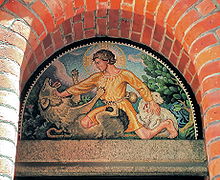
A mosaic on the entrance of a Church building in Denmark depicting the Good Shepherd protecting a lamb from a wolf
The Bible contains 13 references to wolves, usually as metaphors for greed and destructiveness. In the New Attestation, Jesus is quoted to have used wolves as illustrations to the dangers His followers would have faced should they follow him (Matthew 10:16, Acts twenty:29, Matthew 7:15)[58]
The Book of Genesis was interpreted in Medieval Europe as stating that nature exists solely to back up man (Genesis 1:29), who must cultivate information technology (Genesis 2:15), and that animals are made for his own purposes (Genesis 2:18–20). The wolf is repeatedly mentioned in the scriptures every bit an enemy of flocks: a metaphor for evil men with a lust for ability and dishonest gain, as well as a metaphor for Satan preying on innocent God-fearing Christians, contrasted with the shepherd Jesus who keeps his flock safe.[ citation needed ] The Roman Catholic Church oftentimes used the negative imagery of wolves to create a sense of existent devils prowling the real world.[ commendation needed ] Quoting from Leviticus and Deuteronomy, the Malleus Maleficarum states that wolves are either agents of God sent to punish sinners, or agents of the Devil sent with God'due south approval to harass truthful believers to test their faith.[49]
However, legends surrounding Saint Francis of Assisi testify him befriending a wolf.[49] According to the Fioretti, the city of Gubbio was besieged past the Wolf of Gubbio, which devoured both livestock and men. Francis of Assisi, who was living in Gubbio at the time took pity on the townsfolk, and went up into the hills to discover the wolf. Soon fright of the animal had caused all his companions to flee, but the saint pressed on and when he found the wolf he made the sign of the cross and commanded the wolf to come to him and injure no one. Miraculously the wolf closed his jaws and lay downwardly at the feet of St. Francis. "Brother Wolf, you practise much harm in these parts and you take done cracking evil ..." said Francis. "All these people accuse you and expletive you... But brother wolf, I would like to make peace betwixt you and the people." And so Francis led the wolf into the town, and surrounded by startled citizens he made a pact between them and the wolf. Because the wolf had "done evil out of hunger" the townsfolk were to feed the wolf regularly, and in return, the wolf would no longer prey upon them or their flocks. In this style Gubbio was freed from the menace of the predator. Francis, ever the lover of animals, even made a pact on behalf of the town dogs, that they would not bother the wolf again.
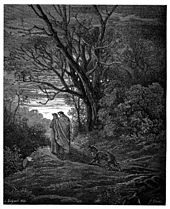
In Canto I of Dante's Inferno, the pilgrim encounters a she-wolf blocking the path to a colina bathed in lite. The she-wolf represents the sins of concupiscence and incontinence. She is prophecised past the shade of Virgil to ane day be sent to Hell by a greyhound.
Much of the symbolism Jesus used in the New Testament revolved around the pastoral culture of Israel, and explained his relationship with his followers as analogous to that of a expert shepherd protecting his flock from wolves. An innovation in the popular image of wolves started by Jesus includes the concept of the wolf in sheep's clothing, which warns people against faux prophets.[59] Several authors accept proposed that Jesus's portrayal of wolves, comparing them to unsafe and treacherous people, was an important development in perceptions on the species, which legitimized centuries of subsequent wolf persecution in the western world.[59] [60] [61] Subsequent medieval Christian literature followed and expanded upon Biblical teachings on the wolf. It appeared in the 7th century edition of the Physiologus, which infused heathen tales with the spirit of Christian moral and mystical teaching. The Physiologus portrays wolves every bit being able to strike men dumb on sight, and of having only i cervical vertebra. Dante included a she-wolf, representing greed and fraud, in the get-go canto of the Inferno. The Malleus Maleficarum, first published in 1487, states that wolves are either agents of God sent to punish the wicked, or agents of Satan, sent with God's blessing to test the organized religion of believers.[62]
The hagiography of the 16th Century Blessed Sebastian de Aparicio includes the account that in his youth, his life was saved in a seemingly-miraculous mode by a wolf. During an outbreak of the bubonic plague in his town in 1514, his parents were forced to isolate him from the community in quarantine, and built a hidden shelter for him in the woods, where they left him. While lying there helpless, due to his illness, a she-wolf found the hiding spot and, poking her caput into his hiding spot, sniffed and so bit and licked an infected site on his trunk, before running off. He began to heal from that moment.[63]
Islam [edit]
Wolves are mentioned three times in the Qur'an, specifically in the Sura Yusuf.
12.thirteen: "He said: Surely it grieves me that you should take him off, and I fright lest the wolf devour him while you are daydreaming of him."
12.fourteen: "They said: Surely if the wolf should devour him notwithstanding that we are a (stiff) company, we should and so certainly be losers."
12.17: "They said: O our male parent! Surely we went off racing and left Yusuf by our goods, so the wolf devoured him, and you volition non believe us though nosotros are truthful."
Mod folklore, literature and pop civilisation [edit]
The popular image of the wolf is significantly influenced by the Big Bad Wolf stereotype from Aesop's Fables and Grimm's Fairy Tales. The Christian symbolism where the wolf represents the devil, or evil, being later on the "sheep" who are the living faithful, is constitute frequently in western literature. In Milton's Lycidas the theological metaphor is made explicit:
- "The hungry Sheep expect up, and are not fed / But swoln with wind, and the rank mist they describe / Rot inwardly and foul contagian spread: As well what the grim Woolf with privy paw / Daily devours apace"
The wolf in the Scandinavian tradition every bit either representing the warrior or protector, sometimes combined with the Christian symbolism equally the wolf representing evil or the devil, came to be a popular attribute in the heavy metal music subculture, used by bands such as Sonata Arctica, Marduk, Watain, Wintersun, and Wolf.
Wolves are a popular species of choice for an individual's "fursona" in the furry fandom.
Run into also [edit]
- Big Bad Wolf
- Footling Crimson Riding Hood
- Throw to the wolves
- Werewolf
- Wolf of Gubbio
- Wolves in fiction
- Wolves in heraldry
- White Fang
- Foxes in popular culture
- African gold wolf#In literature and art
References [edit]
- ^ Lopez 1978, p. 123
- ^ a b c Mech & Boitani 2003, p. 292
- ^ Marvin 2012, pp. 46–47
- ^ Khintibidze, E. (1998), The Designations of the Georgians and Their Etymology, pp. 85-86-87, Tbilisi State University Press, ISBN v-511-00775-7
- ^ a b c Katherine South. Layton (17 Dec 2014). Chechens: Culture and Society. Palgrave Macmillan. pp. 62–63. ISBN978-1-137-48397-iii.
- ^ Robert Seely (2001). Russo-Chechen Conflict, 1800-2000: A Deadly Embrace. Psychology Press. pp. 28–. ISBN978-0-7146-4992-4.
- ^ Kim R. McCone, "Hund, Wolf, und Krieger bei den Indogermanen" in Due west. Meid (ed.), Studien zum indogermanischen Wortschatz, Innsbruck, 1987, 101–154
- ^ a b Eliade 1995, p. eleven.
- ^ Eisler 1951, p. 137.
- ^ a b c d Eliade 1995, p. 13.
- ^ Jeanmaire 1975, p. 540.
- ^ a b Eisler 1951, p. 144.
- ^ a b c Eliade 1995, p. 15.
- ^ Zambotti 1954, p. 184, fig. 13–14, sixteen.
- ^ a b Eliade 1995, p. 23.
- ^ Eliade 1995, p. 27.
- ^ Eliade 1986.
- ^ Pliny the Elder. "8". Historia Naturalis. p. 81. 22/34
- ^ Guerber, Hélène Adeline (1992) [1909]. "Odin's Personal Advent, Greek and Northern Mythologies". Myths of the Norsemen: from the eddas and the sagas (Dover ed.). Mineola, Due north.Y.: Dover Publications. pp. 17, 347. ISBN0-486-27348-2.
At his feet crouched two wolves or hunting hounds, Geri and Freki, animals therefore sacred to him, and of good omen if met past the way. Odin always fed these wolves with his own hands from meat set earlier him.
- ^ Suda, la.812
- ^ Murthy, G. KrishnaMythical animals in Indian art, Abhinav Publications, 1985, ISBN 0-391-03287-9
- ^ Wilson, Horace Hayman & Hall, Fitzedward The Vishńu Puráńa: A Arrangement of Hindu Mythology and Tradition, Trubner, 1868
- ^ Wilkins, West. J. Hindu Mythology, Vedic and Puranic, Kessinger Publishing, 2004, ISBN 0-7661-8881-7
- ^ Mary, Boyce (1989). A history of Zoroastrianism. E.J. Brill. p. 279. ISBN9789004088474.
- ^ Yasna, ix. 18–21
- ^ Sinor 1990, p. 153
- ^ Kusmina 2007, pp. 78, 83
- ^ François & Hulsewé 1979, p. 215
- ^ Shiji 《史記·大宛列傳》 Original text: 匈奴攻殺其父,而昆莫生棄於野。烏嗛肉蜚其上,狼往乳之。
- ^ Beckwith 2009, p. 6
- ^ Watson 1993, pp. 237–238
- ^ Mika Rissanen. "The Lupa Romana in the Roman Provinces". Acta Archaeologica Academiae Scientiarum Hungaricae. Akadémiai Kiadó. Retrieved 2016-04-01 .
- ^ Mika Rissanen. "Was There a Taboo on Killing Wolves in Rome?". Quaderni Urbinati di Cultura Classica. Fabrizio Serra Editore. Retrieved 2016-03-28 .
- ^ Marjanović, Vesna (2005). Maske, maskiranje i rituali u Srbiji. p. 257. ISBN9788675585572.
Вук као митска животиња дубо- ко је везан за балканску и српску митологију и култове. Заправо, то је животиња која је била распрострањена у јужнословенским крајевима и која је представљала сталну опасност како за стоку ...
- ^ Brankovo kolo za zabavu, pouku i književnost. 1910. p. 221.
Тако стоји и еа осталим атрибутима деспота Вука. По- зната је ствар, да и вук (животиња) има зпатну уло- I у у митологији
- ^ .
У старој српској ре- лигији и митологији вук је био табуирана и тотемска животиња.
- ^ Miklosich, Franz (1860). "Die Bildung der slavischen Personennamen" (in German). Vienna: Aus der kaiserlich-königlichen Hoff- und Staatdruckerei: 44–45.
- ^ Karadžić, Vuk Stefanović (1852). Српски рјечник (in Serbian). Vienna: Typis congregationis mechitaristicae: 78.
- ^ Walker 2005, p. 132
- ^ Walker, Brett L. (2005). The Lost Wolves Of Nihon. p. 331. ISBN0-295-98492-ix.
- ^ Монголын нууц товчоо
- ^ Severin, Tim (2003). In Search of Genghis Khan: An Exhilarating Journey on Horseback Across the Steppes of Mongolia. p. 280. ISBN0-8154-1287-eight.
- ^ Jasper Becker. "Outlaw or Hunting Wolves". Mongolia Today. Archived from the original on September 16, 2007. Retrieved 2007-09-12 .
- ^ Wink, André (2002). Al-Hind: The Making of the Indo-Islamic Globe. Brill Bookish Publishers, p. 65. ISBN 0-391-04173-8.
- ^ Walker 2005, pp. 83–84
- ^ Cultural Life – Literature Turkey Interactive CD-ROM. Retrieved on 2007-08-11.
- ^ T.C. Kultur Bakanligi. Nevruz Celebrations in Turkey and Central Asia. Ministry of Culture, Republic of Turkey. Retrieved on 2007-08-11,
- ^ a b "Native American Indian Wolf Legends, Pregnant and Symbolism from the Myths of Many Tribes". www.native-languages.org . Retrieved 23 April 2018.
- ^ a b c d Lopez, Barry (1978). Of wolves and men. p. 320. ISBN0-7432-4936-4.
- ^ 50. David Mech & Luigi Boitani (2001). Wolves: Behaviour, Ecology and Conservation. p. 448. ISBN0-226-51696-2.
- ^ Lopez 1978, p. 133
- ^ "Native American Indian Wolf Legends, Pregnant and Symbolism from the Myths of Many Tribes". Native American Wolf Mythology . Retrieved March 27, 2017.
- ^ Wollert, Edward. "Wolves in Native American Religion". Wolf Vocal Alaska . Retrieved March 27, 2017.
- ^ "Cherokee Legend - Ii Wolves". world wide web.firstpeople.united states of america . Retrieved 23 April 2018.
- ^ "Check the tag on that "Indian" story". 21 February 2012.
- ^ http://world wide web.awakin.org/read/view.php?tid=927 |title= Cheque the tag on that 'Indian story' |
- ^ "The Wolf in Native American Folklore by Running Deer". totemtalk.ning.com . Retrieved 23 Apr 2018.
- ^ Brilliant, Michael (2006). Beasts of the Field: The Revealing Natural History of Animals in the Bible. p. 346. ISBNone-86105-831-iv.
- ^ a b Marvin 2012, pp. 43–45
- ^ Lopez 1978, p. 208
- ^ Mech & Boitani 2003, p. 293
- ^ Lopez 1978, pp. 205, 219 & 240
- ^ Markey, Greg, Male parent (14 Feb 2013). "Blessed Sebastián de Aparicio". Fairfield County Catholic . Retrieved 25 Feb 2013.
Sources [edit]
- Beckwith, Christopher I. (16 March 2009). Empires of the Silk Route: A History of Central Eurasia from the Bronze Age to the Present. Princeton University Press. ISBN978-1400829941 . Retrieved 30 December 2014.
- Eisler, Robert (1951). Man into wolf: an anthropological estimation of sadism, ii, and lycanthropy. London: Routledge and Kegan Paul. ASIN B0000CI25D.
- Eliade, Mircea (1986). Zalmoxis, the vanishing God: comparative studies in the religions and folklore of Dacia and Eastern Europe. Academy of Chicago Press. ISBN978-0226203850.
- Eliade, Mircea (1995). Ivănescu, Maria; Ivănescu, Cezar (eds.). De la Zalmoxis la Genghis-Han: studii comparative despre religiile și folclorul Daciei și Europei Orientale [From Zalmoxis to Genghis Khan: comparative studies in the religions and folklore of Dacia and Eastern Europe] (in Romanian) (Based on the translation from French of De Zalmoxis à Gengis-Khan, Payot, Paris, 1970 ed.). București, Romania: Humanitas. ISBN978-9732805541.
- François, Anthony; Hulsewé, Paulus Hulsewé (ane January 1979). China in Primal Asia: The Early Stage: 125 BC - AD 23; an Annotated Transl. of Chapters 61 and 96 of the History of the Former Han Dynasty. With an Introd. by M.A.North.Loewe. Brill Archive. ISBN9004058842 . Retrieved 30 May 2015.
- Jeanmaire, Henri (1975). Couroi et courètes (in French). New York: Arno. ISBN978-0405070013.
- Kusmina, Elena Efimovna (2007). The Origin of the Indo-Iranians. Brill. ISBN978-0521299442 . Retrieved February 13, 2015.
- Lopez, Barry H. (1978). Of Wolves and Men. J. M. Dent and Sons Limited. ISBN978-0-7432-4936-2.
- Marvin, Garry (2012). Wolf. Reaktion Books. ISBN978-1-86189-879-i.
- Mech, L. David; Boitani, Luigi, eds. (2003). Wolves: Behaviour, Ecology and Conservation. University of Chicago Printing. ISBN978-0-226-51696-7.
- Sinor, Denis (one March 1990). The Cambridge History of Early on Inner Asia, Volume one. Cambridge University Press. ISBN0521243041 . Retrieved ane January 2015.
- Watson, Burton (1993). Records of the Grand Historian of China. Han Dynasty II. Chapter 123. The Account of Ta-yüan. New York City: Columbia University Press.
- Walker, Brett L. (2005). The Lost Wolves Of Japan. Academy of Washington Press. ISBN978-0-295-98492-6.
- Zambotti, Pia Laviosa (1954). I Balcani e fifty'Italia nella Preistoria (in Italian). Como.
baumannapidention39.blogspot.com
Source: https://en.wikipedia.org/wiki/Wolves_in_folklore,_religion_and_mythology
0 Response to "Native Women With Black Wolf Native Women With Wolf Art"
Enregistrer un commentaire